Details still missing
Capture cargo, packages and open points in one brief. Keep unknown dimensions explicitly marked as unknown.
Prepare a complete transport request for valuable goods ↗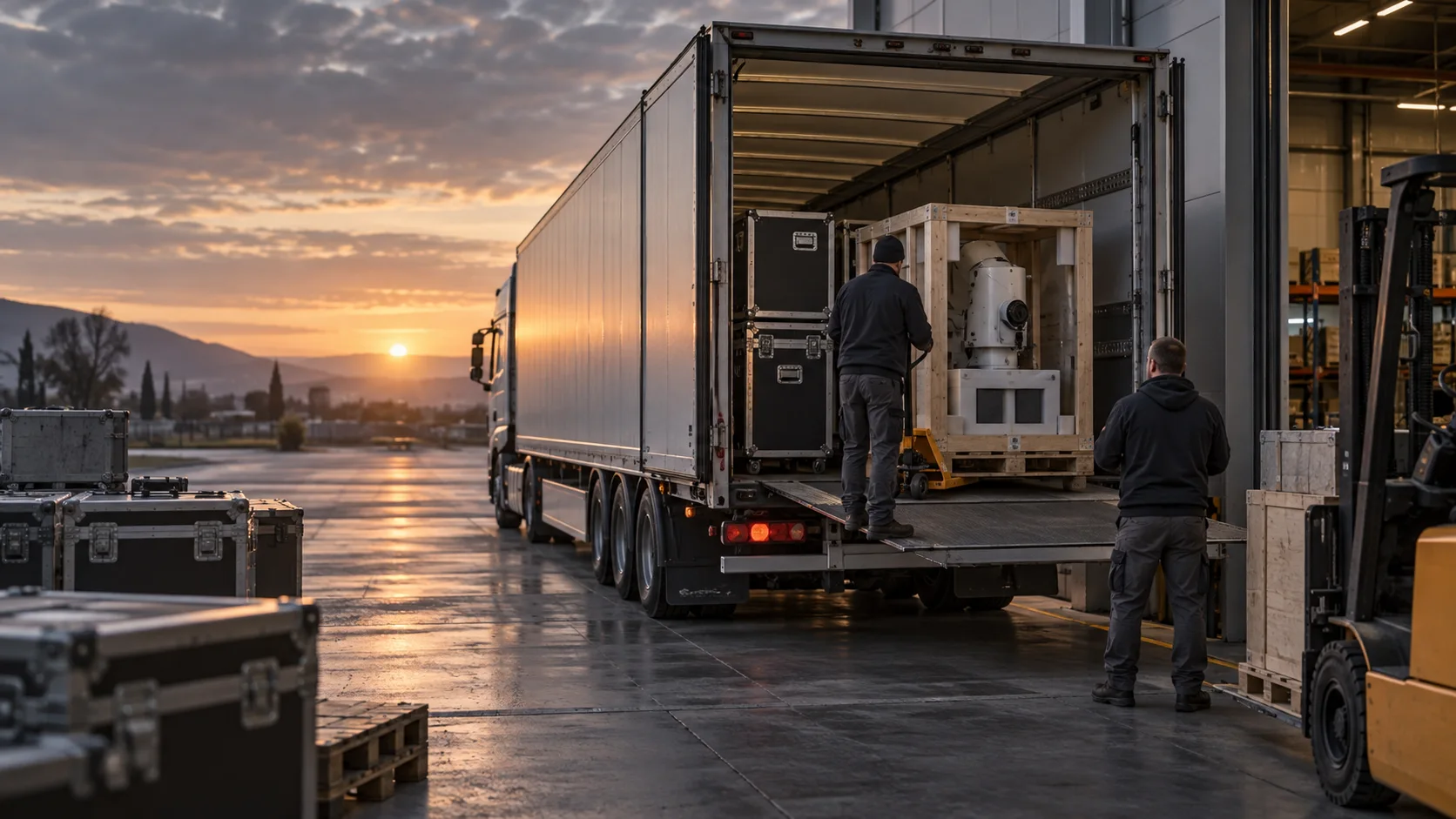
High-value transport
Choose the next unresolved decision. This guide moves from an initial brief through comparable quotations to confirmed handovers and destination details.
Capture cargo, packages and open points in one brief. Keep unknown dimensions explicitly marked as unknown.
Prepare a complete transport request for valuable goods ↗Give both providers the same quantities, timing and scope. Mark differences before comparing prices.
Compare quotes for specialist transport transparently ↗Assign preparation, receipt and time-window confirmation to specific people.
Clarify kerbside handover or delivery to the final position ↗Choose the actual collection and receiving locations. Define whether the job ends at a terminal or at the final address.
Countries & routes ↗Use the same enquiry basis for both quotations in each row. “Open” does not mean included. Select and copy the fields into your own document.
| Comparison point | Common enquiry basis | Quotation A | Quotation B |
|---|---|---|---|
| Outbound, return and onward legs with final addresses | Enter / confirm | Enter / confirm | Enter / confirm |
| Packages, packed dimensions and weight per direction | Enter / confirm | Enter / confirm | Enter / confirm |
| Readiness, receiving windows and deadlines | Enter / confirm | Enter / confirm | Enter / confirm |
| Handover point and movement within the site | Enter / confirm | Enter / confirm | Enter / confirm |
| Packaging, loading and unloading: who does what? | Enter / confirm | Enter / confirm | Enter / confirm |
| Waiting-time terms and additional tasks | Enter / confirm | Enter / confirm | Enter / confirm |
| Open assumptions, exclusions and approvals | Enter / confirm | Enter / confirm | Enter / confirm |
| Total price, currency and validity | Enter / confirm | Enter / confirm | Enter / confirm |
A useful request answers four questions first: what is being moved, how it is packed, from where to where, and by when. The clearer these answers are, the faster it can be checked which transport scope suits your project and which points still need clarifying.
Transport planning depends on the external dimensions of the fully packed item, not on the catalogue measurements of the goods. A crate, pallet, padding or cover often changes length, width, height and weight considerably. These values determine load space, handling and access at the destination.
Whether existing packaging suits the planned transport depends on the goods, the route and the handling. Describe what the packaging is made of, how the item is secured inside and whether it is designed to be opened several times. Photos of the inside and outside help with the assessment.
The lead time a transport needs depends less on the distance than on the preparations still open. Packaging, internal approvals, access arrangements and contacts need to be settled before a date becomes reliable. Plan backwards from the moment the goods are needed at the destination.
Many delays happen not on the road but at the door. For both addresses, describe how a vehicle can approach, where it can stop and what route leads to the goods or the destination room. Small details such as thresholds or tight corners matter.
When a shipment consists of many packages, the packing list becomes the most important planning document. It shows what belongs together, what is needed first and whether everything is complete at handover. Without numbering, even simple queries quickly become confusing.
Some valuable goods react to cold, heat or condensation. If this applies to your shipment, the requirement should appear in the request as a specific range, not as a general remark. Whether and how it can be taken into account is then checked for the project.
With unreleased products or internal projects, companies often want to reveal as little as possible about the contents. A neutral description containing all handling-relevant details is usually enough for planning. What exactly needs to be treated confidentially should be raised explicitly before the order is placed.
A handover works when someone reachable at both the collection and destination address knows what is coming and what to do. For valuable shipments, name a specific contact person with a direct phone number rather than the general switchboard.
A time window describes when the handover can take place, not just when it ideally should. The better you know the actual possibilities at the collection and delivery address, the more reliably the process can be agreed.
A short, consistent condition record at the beginning and end of the transport creates clarity for everyone involved. It helps answer later questions objectively and avoids long discussions about the original state of a package.
Accompanying documents link the physical shipment to your internal processes. The delivery note, packing list and, where needed, a handover record should be prepared so that the recipient can see without asking what they are receiving and what they need to confirm.
If the intended person is not there when the shipment arrives, the immediate question is who else may accept it. For valuable goods, this decision should not be made spontaneously at the door but agreed in writing beforehand.
In office buildings with a central reception or gatehouse, the journey often does not end with the actual recipient. Who signs in, who collects and where the shipment goes in the building should be settled in advance so that valuable goods are not left waiting in the lobby.
Whether a shipment is handed over at the vehicle, on the ground floor or directly at its final position makes a big difference to staffing, time and planning. The desired handover point should therefore be stated precisely in the request rather than settled on arrival.
If the recipient notices damaged packaging, a missing package number or another discrepancy on receipt, an immediate and factual note is what matters most. It records what was visible at the time of handover without assessing causes.
The price of transporting valuable goods is not determined by distance alone. Size and weight of the shipment, the effort at collection and delivery, time requirements and additional services matter at least as much. Knowing these factors helps you phrase your request more precisely.
Two quotes for the same transport are only comparable if they are based on the same assumptions. So look not only at the final price but at the services, dates and conditions each quote is based on.
A dedicated trip reserves vehicle capacity for your shipment and the agreed journey. Its price depends on the route, date and scope of service. Ask the quotation to specify the journey components and additional services included, rather than assuming an entire outward and return trip is charged.
Waiting time occurs when goods are not ready on arrival, the contact person is missing or an approval is pending. It extends the job and can lead to additional costs. Much of it can be avoided with clear preparation.
Beyond the transport itself, valuable shipments often require further steps: packing, carrying up stairs, unpacking or removing empty packaging. Naming such services separately makes it clear what has been agreed and what your own team will handle.
For valuable shipments, the value of the goods belongs in the request even if it is not the most important planning factor. It helps assess what cover may be relevant for your project. Which liability applies in the specific case and what should be additionally covered must be clarified before the order is placed.
If similar shipments are regularly moved between the same locations, it pays to describe the overall need instead of requesting each journey from scratch. This allows processes to be standardised and budgets for a period to be estimated more realistically.
Projects shift, goods are finished later or an appointment is cancelled. For planning, it is crucial that changes become known as early as possible. The consequences of postponing or cancelling follow from the agreed terms.
Good to know
When both cover the same goods, directions, dates and handover points, with responsibilities and open assumptions described consistently. Mark differences in packaging, handling, waiting-time terms and validity before comparing prices.
Request transport
Describe your cargo, route and preferred dates. Together we turn these details into the basis for an individual quotation.
Your details and files are transmitted in encrypted form via Cloudflare and Google Workspace (Gmail) as an email to the No-Cargo dispatch mailbox.
Your entries remain when moving between steps. They are not saved when the page is reloaded.